
NYM Food Shelf celebrates March Food Share Month
News | Published on March 3, 2026 at 4:09pm GMT+0000 | Author: Kendall Koenen
0Demand of New York Mills food shelf continues to rise
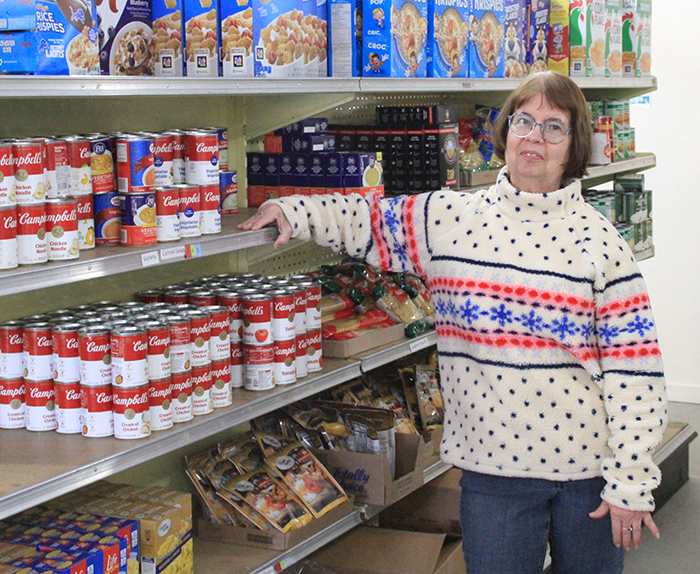
Connie Warner has been an active member of the New York Mills Food Shelf since its inception in 1992. Along with many volunteers, she helps to keep the organization thriving.
By Tucker Henderson
Reporter
While the New York Mills Food Shelf may often go unnoticed by many local residents, the impact of the mission and operation of the nonprofit safety-net is felt widely by those community members who really need it.
The NY Mills Food Shelf began in February of 1992 after two successive food shelves in town were phased out to make space for other needs for the community. As the last of the early food pantries were dissolving, the Otter Tail-Wadena Community Action Council encouraged NY Mills to apply for their own 501c-3 nonprofit to continue the mission.
Connie Warner, who had worked with the Community Action Council, acted as a liaison and wrote the original 501c-3 in order to get the new group’s efforts into fruition. A board was set up with at-large community members as well as appointees from each of the churches in town. The NY Mills Lions built them their own building in 1995 where the Food Shelf calls its home to this day.
“I’ve been the treasurer and emergency food contact the whole time,” said Connie Warner. “I worked with organizing the churches to create the Food Shelf at the time.”
Warner said that from the very beginning, the community has been an incredible supporter of the food shelf and its ongoing needs. Even over the past few years as usage has gone up and funding has gone down, the community continues to keep the shelves full and their neighbors from going hungry.
“The community response for donations has always been wonderful,” said Warner. “It’s a needed service and the usage has gone up. In fact, 2025 was the highest household usage we’ve ever had. The impact of the great community support has always been there.”
In 2025, the NY Mills Food Shelf served 642 families and 1,610 individuals. They distributed 51,300 pounds of food and saw the highest usage on record with 313 new visits during the past year. They also received over $15,000 in March FoodShare donations and 748 pounds of food during their month of fundraising.
March is an important month for food shelves around the state as MN Food Share program gives additional funding to food pantries across the state, depending on their donations during the month. The statewide program was set up decades ago to help fight food insecurity, which has been on the rise.
MN Food Share reports that annual visits to food shelves were over 150 percent higher than they were prior to the COVID-19 pandemic. The food shelf is always happy to accept donations of food and funds throughout the year, but is especially asking for donations throughout the month of March in the hopes of receiving some additional funding from the MN Food Share program.
“March Food Share Month is our major fundraising time for the food shelf,” said Warner. “It’s very important because we receive additional funds earned based on our donations. We’re grateful for the community support, that’s always been there. Anytime we have been particularly getting low, they step right up to help.”
Since the beginning, there have been several changes in the food shelf’s operation. One change was the transition from prepackaged boxes to a client choice model, where those utilizing the food shelf were able to pick out items that were the best choice for their families. Vouchers for perishable products such as milk, eggs and produce are also given out during distribution day as they aren’t able to keep those food items on hand.
Another more recent change was the addition of open hours later in the day, especially for those who weren’t able to go to the food shelf during the day while they were at work. Though Warner was initially wary of a lack of use for those later hours, she was happily surprised when a number of households showed up and continue to utilize the later time.
“The majority of people still come in the morning, but we get probably eight or nine households in the afternoon, so it’s been very worthwhile. We didn’t do it in the past because we didn’t really have enough volunteers, but some new volunteers were willing to take that time.”
Warner estimates that with the volunteers who help out with distribution, the board of directors and others who do a wide variety of essential tasks, there are about 25-35 total volunteers in a given month and around 60 hours worth of volunteering is accounted for on average.
“We appreciate the volunteers, it’s strictly volunteer here,” she said. “They make it work, the food shelf wouldn’t exist without all the volunteers.”