
Secretary of State visits NY Mills School
News | Published on March 3, 2026 at 4:11pm GMT+0000 | Author: Kendall Koenen
0By Tucker Henderson
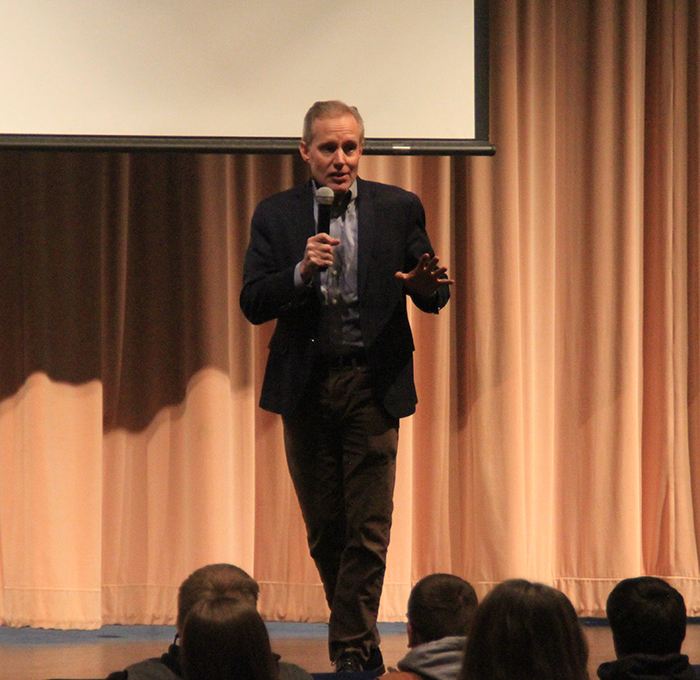
Minnesota Secretary of State of State Steve Simon recently visted the NY Mills School and talked about his role at the state level, elections, and answered questions from the student body.
Reporter
It’s not everyday that the Secretary of State comes to speak in small-town Minnesota, but that’s exactly what happened on Thursday, Feb. 19 at the New York Mills School. Minnesota Secretary of State, Steve Simon, spoke to and answered questions from local students during an hour-long visit in late February.
Simon was invited to speak in NY Mills and later in the day was in Detroit Lakes by West Central Initiative. The organization worked in cooperation with the school, as well as in partnership with the local Leagues of Women Voters, who were available to help eligible voters register for the coming year.
During the hour presentation, Simon spoke to students about his duty as Secretary of State in Minnesota, as well as his office’s role in the state election system and voting. He said that around 30,000 people are needed each election day in Minnesota as election judges and mentioned that students can fill those roles as early as age 16 in Minnesota.
He also spoke about the difference in ballots including absentee and military ballots, pre-registration for voting, and how he originally got into politics. Towards the end of the program, he received a fair amount of questions from NY Mills students including questions about popular vote versus the electoral college, the state versus federal elections, voting age, whether he had seen a decline in younger voting (which he said was quite the opposite), thoughts on ICE and the SAVE Act and vouching system in Minnesota.
One student asked about the vouching system in Minnesota, which allows another eligible voter in the same precinct to vouch for one’s residency within that same precinct. This only provides proof for residence and can only be done for a maximum of eight people per vouching citizen.
“Let me give you an example close to home for me about vouching,” said Simon. “My parents moved out of the house I grew up in, they downsized and moved into a condo in a different city, different legislative district. They had moved in the fall, so they didn’t have a new driver’s license reflecting the new address, they didn’t even have a utility bill yet or anything that they could use to show that they lived where they said they lived, so what do you do in that situation?
“You just moved, you don’t have the new stuff for your new address, so if you want to vote at your new place of residence, what do you do?” he continued. “That’s why we have vouching. So my dad could not have voted in that election, which was a governor’s election that year, unless he had a neighbor vouch for him. It is someone that lives in your precinct, they have to be an eligible voter in Minnesota, and that person vouches not who you are, but vouches for the fact that you really live there.
“So one of my dad’s new neighbors was able to say ‘yes, I’m swearing under penalty of perjury, he really does live there,’ and all of this is law in Minnesota. Both the voucher and vouchee have to sign a piece of paper, the voucher has to show some ID so we know that person is an eligible voter and it’s all logged, and you can only do it for up to eight people. The vouchee still has to provide an ID to prove they are who they say they are.”
Another question from the audience was asking his personal thoughts on the SAVE Act. The Safeguarding American Voter Eligibility (SAVE) Act is a proposed law making it’s way through the nation’s capitol which would require documentary proof of United States citizenship in order to vote in each election.
“It was passed last year by the US House, it had another vote here recently in the US House,” said Simon. “So documentary—this means you have to show papers that prove that you are a citizen in order to register to vote. I totally understand why anyone who hears just that would say, ‘well, that seems totally reasonable,’ because citizenship is one of the few things that you need to be a voter. You need to be 18, a citizen, and a resident where you say you’re a resident, those are the big three, it seems pretty reasonable that you would have to show some documents for that, I get that.
“In my view, the problem with it namely is that there are about 69 million American women who have a different last name now than the one they were born with,” he continued. “North of 20 million of those do not have a US passport. So what do you do in that situation? A driver’s license is not proof of citizenship, so what do you do? What’s the document that you show? Well, if you’re in that boat, you probably have to show two sets of documents—a birth certificate and a marriage record—and maybe we’ll be able to produce both of those, but maybe we won’t be able to produce both of those or maybe one of those two. So it’s one of those things that I understand the surface appeal, but I think we need to think through how this will really play out in the real world. I just think in the implementation, there are some practical problems that need to be thought through.”
After a good variety of questions from the student body and with time wrapping up, Simon expressed his gratitude to the students for their time and great questions during the hour he was there.
“I really hope that all of you, when you’re eligible to vote, will vote,” he finished, “Thanks a lot everybody, I just want to thank you all!”