

growing a bountiful harvest in nym
News | Published on October 16, 2026 at 4:19pm GMT+0000 | Author: Kendall Koenen
0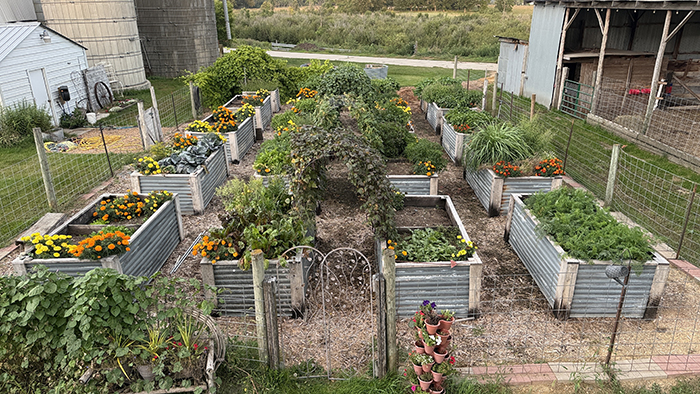
By Chad Koenen
Publisher
ucked away in an otherwise desolate prairie just outside of New York Mills is a place where vegetable plants grow as far as the eyes can see. Sprinkled in-between the large green vegetables are speckled shades of red from approximately 200 tomato plants, while large raised plant beds and unique greenhouses made from grain bins transform small seeds into an oasis of opportunities of healthy eating opportunities for Jim Formanek and his wife LouAnn Muhm. ¶ The garden is a harvest of passion, especially for Muhm, who enjoys spending her summer in the approximately 5,000 square feet of raised beds, greenhouses and endless possibilities for what may come to fruition through her hard work each spring and summer. ¶ “It’s just a real outlet for me,” said Muhm. “Everyone is always like it is so much work, but to me it’s a different kind of work because I am a teacher and a writer so it is nice to do a different kind of work.”As she prepares the large garden area each spring, Muhm said there is a certain amount of excitement that comes with planting a garden. While the gardening season has more-or-less ended for the year, the fall harvest is something to be enjoyed when thinking that all of the green plants came from just a few small seeds that were planted in the ground.
“There is something about growing things. I have this in the ground and every August I think all of this came from a handful of seeds,” said Muhm. “I just think it is miraculous and I love being able to make that happen. I throw a few seeds in the ground and I can feed all these people, myself and my family.”
Gardening isn’t anything new for Muhm. The local resident fondly remembers her parents gardening when she was growing up. Even though she didn’t help with the garden much as a child, the lessons she learned and being able to see first-hand the benefits of growing one’s own food planted a seed that was cultivated for her later in life.
“My parents gardened a lot and I didn’t help a lot, but I was always around it,” said Muhm. “My parents moved several times, but at every house they established a garden and it was their hobby so I think I just absorbed it.”
After all, by growing one’s own food a person knows exactly where the item came from and what was used on the plant, providing a unique freshness that can only be enjoyed by harvesting and eating an item on the same day. Over the course of the fall the family is busy canning vegetables to eat throughout the winter months, which allows them to continue to eat farm-fresh items nearly year round.
In order to share the bounty on what can only be described as a massive home garden with others, Muhm and Formanek began Sunset Grove several years ago behind Muhm’s passion for gardening. The first spring after moving to the NY Mills area, Muhm began a Community Supported Agriculture (CSA) with a group of raised garden beds and believed she could transform the countryside into an oasis of bountiful food.
A CSA is basically a direct-to-consumer farming model where people buy “shares” of a farm’s harvest up-front in exchange for regular boxes of fresh, seasonal produce or farm goods. In hindsight Muhm is thankful that her ambitious endeavor worked out, even if she had never grown vegetables or plants on the land near NY Mills before, but it also provided her a way to distribute the massive amount of vegetables that come from her farm each summer and fall.
“Looking back I cannot believe my overconfidence, but I started a CSA even before I started,” said Muhm of starting the CSA six years ago. “The hubris of I’ve never grown any food in this spot, but I am going to supply food to these people all summer long.”
Over the course of the next few years Sunset Grove turned into a popular CSA with local residents who shared in the bountiful harvest that Muhm had each summer long. After injuring her knee last year in which Muhm tore her meniscus off the bone and moving family to the area from out of state, the rural NY Mills farm didn’t provide a CSA program this summer as she recovered from surgery. However, the garden itself stayed pretty close to its original 5,000 square feet, which included some 200 tomato plants.
Instead of a CSA, which Muhm said will likely be back next year now that she is recovered from knee surgery and her family is now in the area, the local family sold vegetables by the side of the road and even went to a farmers market with some of their harvest to sell. Whatever was left over was brought to the Wadena and Sebeka Food Shelves to provide fresh vegetables to those in need this past summer.
While the CSA provided some funding to help pay for the garden itself, Muhm said the business didn’t necessarily make money, but was more of a way to justify having such a large garden in the first place.
“Even with the CSA I don’t make money, it’s a way to justify having such a large garden,” she said. “We don’t need more (food) and what is the harm? I enjoyed doing it. I enjoyed having the plants. I enjoyed having the seeds and I enjoyed gardening and that is the pay off.”
In order to help with the planting and harvest this summer, NY Mills teenager Heta Tervola-Hultberg was a regular at the farm as she helped to do everything from weed to harvesting the vegetables.
“It was so fun to have her and plus it was fun to have someone to help with (the garden),” said Muhm.
With several unique greenhouses already on the property, Muhm said Formanek is already hard at work at converting another grain bin into a new oasis of growth for next year. Even though Muhm said they don’t necessarily need another greenhouse, the project melds a hobby for both of them, gardening for her and giving a new chance at life through repurposing older buildings and objects for Formanek.
What’s more, since much of the products being used on the grain bin greenhouse is recycled materials and the plants each summer are from seeds, there isn’t much cost for the family in having such a large garden space, just a lot of elbow grease, timely rain and a lot of patience during a warm Minnesota summer.
“We’ve put a considerable amount of cost of rate materials for the raised beds, but the seeds themselves, they don’t cost much and the cans you can reuse every year,” said Muhm.
For more information about Sunset Grove and its CSA program, visit Sunset Grove on Facebook.