

A Finnish Farmer Leaving Home
Published on March 17, 2026 at 2:58pm GMT+0000 | Author: Tucker Henderson
0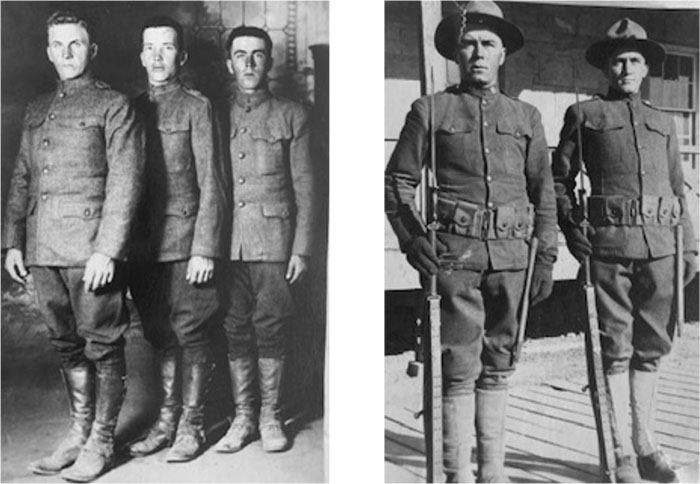
Left photo: Eddie is on the left. Right photo: Eddie is on the right.
By Ruth Koehler
Special to the Dispatch
Eddie Bakko was one of two thousand men from Otter Tail County who left their homes between 1917-19 to serve during the first World War. Eighty-seven died either in battle or in army bases or hospitals.
As Eddie milked cows and did his morning chores, he did so with haste, as he had a schedule to keep. You see, he would be heading to Fergus Falls via New York Mills to join the army. The United States had entered World War I 18 months ago, and more soldiers were needed to keep the Germans away from France.
Eddie had mixed feelings. At age 21, was he happy, scared, ambivalent? All he knew was milking cows and farm work. Eddie and a few of his friends in Otter Tail County were called upon to help in this war. Eddie’s parents, Henry and Breda, cautioned “Just do your best and don’t try to be a hero.”
Brother John knew by Eddie’s leaving, he’d be left with more work. There were cows to milk morning and night, fields to be plowed, and crops to plant and harvest.
John felt responsibility taking his younger brother by horse and buggy to the train station in New York Mills from which the soldiers would travel to Fergus Falls and then be taken to various boot camps.
“I’ll write to you and the folks when I get the chance––I’m not sure where they’ll send me,” Eddie said, wishing the horse would speed up.
The Sebeka newspaper and the radio gave ongoing reports letting Eddie know America was ready to meet the Kaiser and do whatever was needed to bring down the German army.
Armed forces had been fighting in France with soldiers dying in battles, including the Battle of the Argonne Forest. Eddie wasn’t sure where he’d be sent but knew it would be more adventurous than Sebeka and farming.
As he prepared to leave the farm and the Paddock area, Eddie packed very little as he wouldn’t need much, only his bible plus some family photos. John waited patiently after hitching up the horse and buggy. Eddie stiffly shook his dad’s hand and gave his mom an awkward hug, “I’ll write as soon as I can. Take good care of the farm.” Henry and Breda were sad as their youngest was leaving home and not knowing his future.
“Eat well, Breda said.” Keeping a stoic countenance on his Finnish face, Eddie jumped into the buggy heading to New York Mills.
From army pictures, one can’t tell by Eddie’s expression if he was excited, happy, or sad. I’d venture to guess all the young men wondered if they’d see action, end up fighting in France’s deadly battles, or be lucky enough to not fight. One thing they did know–––they’d be doing some traveling.
In actuality, he traveled to Fort Wingate, New Mexico, transferred from the 97th Division Infantry to Ordinance Dept. 97th Division. He mustered out of service on June 4th, 1919, at Fort Wingate, New Mexico. Of course Eddie didn’t know the war would end so soon and that he’d muster out after eight months. The men look ready to serve, with uniforms on, boots on, and guns ready. At his young age, Eddie had known a different life from October into June.
Upon arriving back home, the farm had changed very little, the cows still knew him and the fields waited. Henry, Breda, and John were happy to have him home. We can only surmise what Eddie was feeling. I’m sure he looked forward to his weekly sauna.
Since Eddie married at age 42, I was thankful to find out more about my father’s early life and his venture into World War I.
Resource: Otter Tail County, Minnesota in the World War, 1917, 1918, 1919